'Let’s Buy Spirit' Explained: How the Campaign Works, Total Raised, and What's Next
 By David Miller
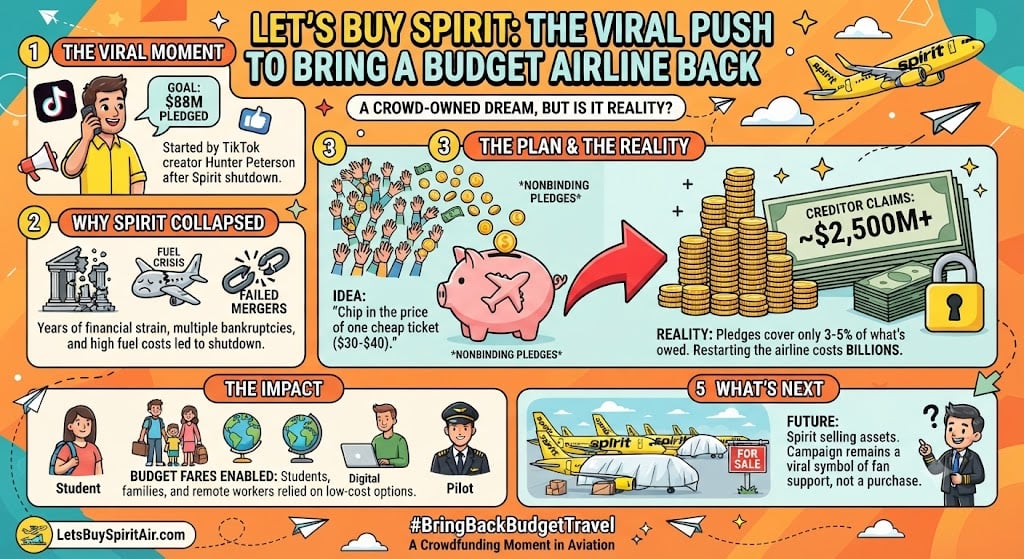
Even if campaign leaders could immediately convert all $214 million into cash, commercial aviation is heavily insulated against decentralized or ad-hoc buyouts. The barriers to buying an airline involve complex federal frameworks designed to maintain strict oversight.
First, an airline does not exist merely as an assortment of yellow aircraft and gate signs. An operating carrier requires an FAA Part 121 Air Carrier Operating Certificate and continuous Department of Transportation economic authority. Under federal statute, the DOT assesses whether an entity possesses the financial fitness, operational competence, and compliance disposition to fly. Handing leadership decisions to a loose syndicate of social media users does not satisfy federal fitness standards.
Second, strict statutory rules govern airline ownership. Under 49 U.S.C. § 40102, an American air carrier must be a citizen of the United States. That requires the president and at least two-thirds of the board of directors to be U.S. citizens, with at least 75% of the voting interest owned or controlled by U.S. citizens. A permissionless, globally shared crowdfunding campaign cannot guarantee compliance with foreign ownership caps without vetting every single backer.
Finally, there is the reality of Spirit's bankruptcy estate. Spirit entered court protection carrying billions in funded debt, aircraft lease contracts, engine overhaul obligations, and vendor liabilities. Senior secured creditors hold priority claims on Spirit's actual assets, including its gates, slots, and intellectual property. A $214 million retail bid is a fraction of the capital needed to resolve creditor claims and secure an operational fleet.
David Miller brings 15 years of experience in global economics, personal finance strategy, and market dynamics. He specializes in turning complex economic trends into actionable insights for everyday readers.
