What Those Numbers Mean at the Dentist: Why Your Mouth Is Mapped 1 to 32
 By Robert Thorne
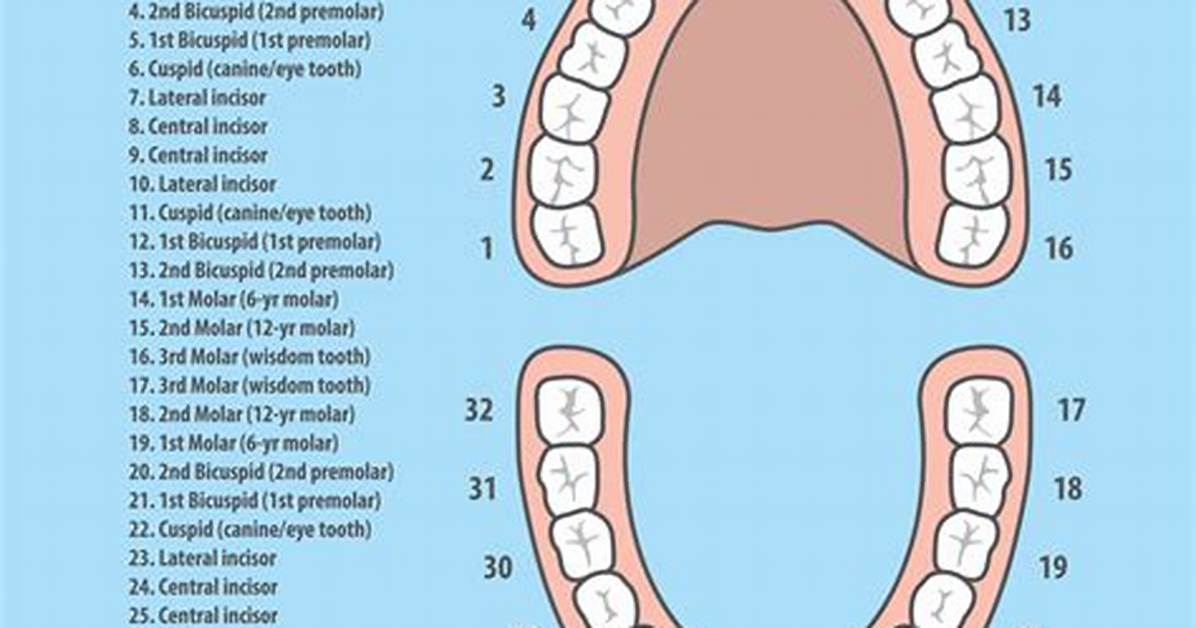
Q1: Why do dentists tap teeth and call out letter codes like MOD or DO?
A1: Letters identify specific tooth surfaces requiring restoration. Mesial (M) faces the front of the mouth, Distal (D) faces the back, Occlusal (O) is the chewing surface of molars, Incisal (I) is the cutting edge of front teeth, Buccal or Facial (B/F) touches the cheek, and Lingual (L) borders the tongue. A "MOD on #14" means a cavity spans the mesial, occlusal, and distal surfaces of that upper molar.
Q2: How are baby teeth numbered on a child's chart?
A2: Primary or baby teeth use the English alphabet rather than numerals. Under the Universal System, letters A through T track the 20 primary teeth. Tooth A is the upper-right primary second molar, sweeping to J on the upper left, then dropping to K on the lower left and running clockwise back to T on the lower right.
Q3: If I was born without a wisdom tooth, will my other teeth be numbered differently?
A3: No. The numbering map reflects biological positions, not total teeth present. If you have congenital agenesis of tooth #1, your chart begins physically at tooth #2. Clinicians mark #1 as "congenitally missing," ensuring your central incisors always remain #8 and #9.
Robert Thorne covers electric vehicle innovations, autonomous driving systems, global mobility trends, and automotive engineering developments.
