What Is Mouse Polling Rate? the Complete Guide to Hz, Latency, and Settings
 By Marcus Vance
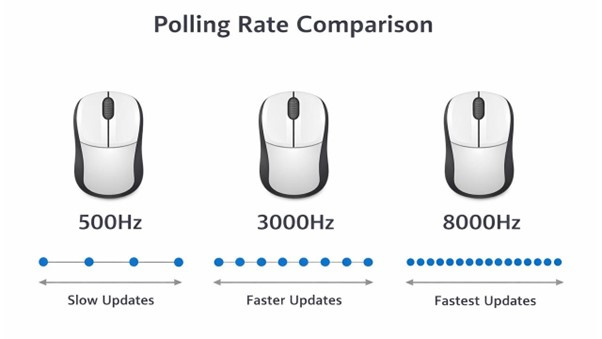
Gamers frequently confuse Dots Per Inch (DPI), technically Counts Per Inch (CPI), with polling rate. They measure two completely distinct layers of peripheral input.
DPI dictates spatial sensitivity. It determines how many individual counts your mouse sensor registers when moved across one physical inch of mousepad surface. If you operate at 800 DPI, moving the mouse one inch outputs 800 discrete coordinate steps. If you set your peripheral to 3,200 DPI, that same physical inch sends 3,200 coordinate steps, making on-screen movement far faster or allowing micro-adjustments within higher-resolution pixel grids.
Polling rate determines temporal resolution. It dictates how many times every second those coordinate steps get reported to Windows, macOS, or Linux. If you pair an extremely low DPI like 400 with an 8,000Hz polling rate, the mouse controller is ready to speak to your CPU 8,000 times per second, but slow hand movements may not generate enough positional counts to populate every report window.
To feed high-polling transceivers saturated data packets, competitive testing from community benchmarks shows that tracking consistency improves when running a base DPI of at least 1,600 DPI to 3,200 DPI, scaling down in-game sensitivity sliders to compensate.
Marcus Vance is a cybersecurity auditor and technology writer dedicated to educating the public about online safety, data privacy regulations, enterprise security, and emerging cyber threats.
