What Is Mouse Polling Rate? the Complete Guide to Hz, Latency, and Settings
 By Marcus Vance
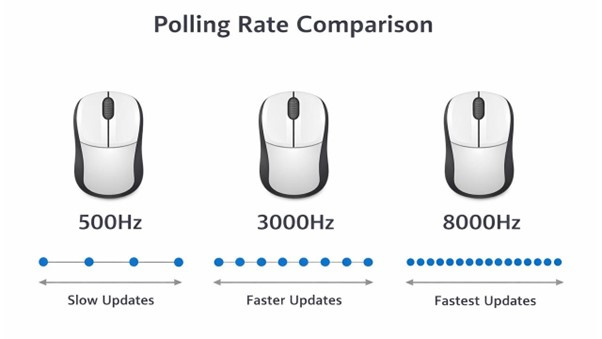
A peripheral sending updates 8,000 times a second offers little perceptual value if your monitor updates its panel 60 times a second. Sensor tracking accuracy and cursor smoothness align directly with your display's refresh rate.
On a standard 60Hz panel, a new frame appears every 16.6ms. At 1,000Hz, the mouse sends roughly 16 updates per display frame, which easily blankets the refresh window. But competitive esports setups in 2026 regularly run panels operating at 240Hz, 360Hz, or 540Hz.
On a 540Hz monitor, a new frame renders every 1.85ms. At 1,000Hz (one packet per 1.0ms), frame render ticks occasionally land slightly out of sync with mouse report arrivals. This timing variance causes microscopic visual micro-jitter: your eyes track an enemy target smoothly, but the spatial gap between cursor positions alternates slightly across adjacent frames.
Bumping your reporting rate to 2,000Hz or 4,000Hz ensures that two to four fresh mouse packets arrive inside every single display frame tick. For professional players competing on ultra-high-refresh OLED or Fast-IPS esports monitors, this creates a mirror-smooth tracking sensation when tracking high-speed targets across the field of view.
Marcus Vance is a cybersecurity auditor and technology writer dedicated to educating the public about online safety, data privacy regulations, enterprise security, and emerging cyber threats.
